
What every Arto Supported Flow includes as standard
Full compliance framework:
UK GDPR, WCAG 2.2, ISO 42001, the OECD AI Principles and the 10 principles of the UK Government AI Playbook are embedded at the platform level. No additional configuration is required.
Pre-linked KSB profile:
each workflow is mapped to the knowledge, skills and behaviours of the relevant public sector role. The AI agent operates within the defined boundaries of that role and cannot act outside them.
Pre-populated assurance records:
the Assurance Designer evidence base is pre-populated for each Arto Supported Flow, providing the documentation required for DPIA supplementary evidence, IT security assessment and information governance sign-off.
Auto-generated audit log:
every execution is captured in a timestamped, immutable audit record covering trigger, data accessed, AI agent actions, human oversight gate decisions, officer sign-off and output produced.
Human-in-the-loop gates:
at every decision point that requires officer approval, the workflow pauses in the HITL Control Centre. The responsible officer reviews the AI output, applies professional judgement and provides a digital sign-off. That decision is permanently attributed and recorded.
Audit trail:
generated automatically on every run and available immediately for ICO review, legal challenge, internal audit or scrutiny committee.
ROI dashboard:
time saved, cost reduced and demand deflected are tracked automatically per workflow run from the first deployment.
Planning and Development workflows
Every Arto Supported Flow is built on the same governance foundation: UK GDPR, WCAG 2.2, ISO 42001, the OECD AI Principles and the 10 principles of the UK Government AI Playbook. The Knowledge, Skills, and Behaviours (KSB) profile mapped to the relevant public sector role is pre-linked. The assurance records are pre-populated. The audit log is generated automatically from the first run.
The workflows below are available now. Where a workflow does not yet exist for your service area, Arto builds it with you. Every custom workflow built on the platform inherits the same governance foundation as the pre-built flows.
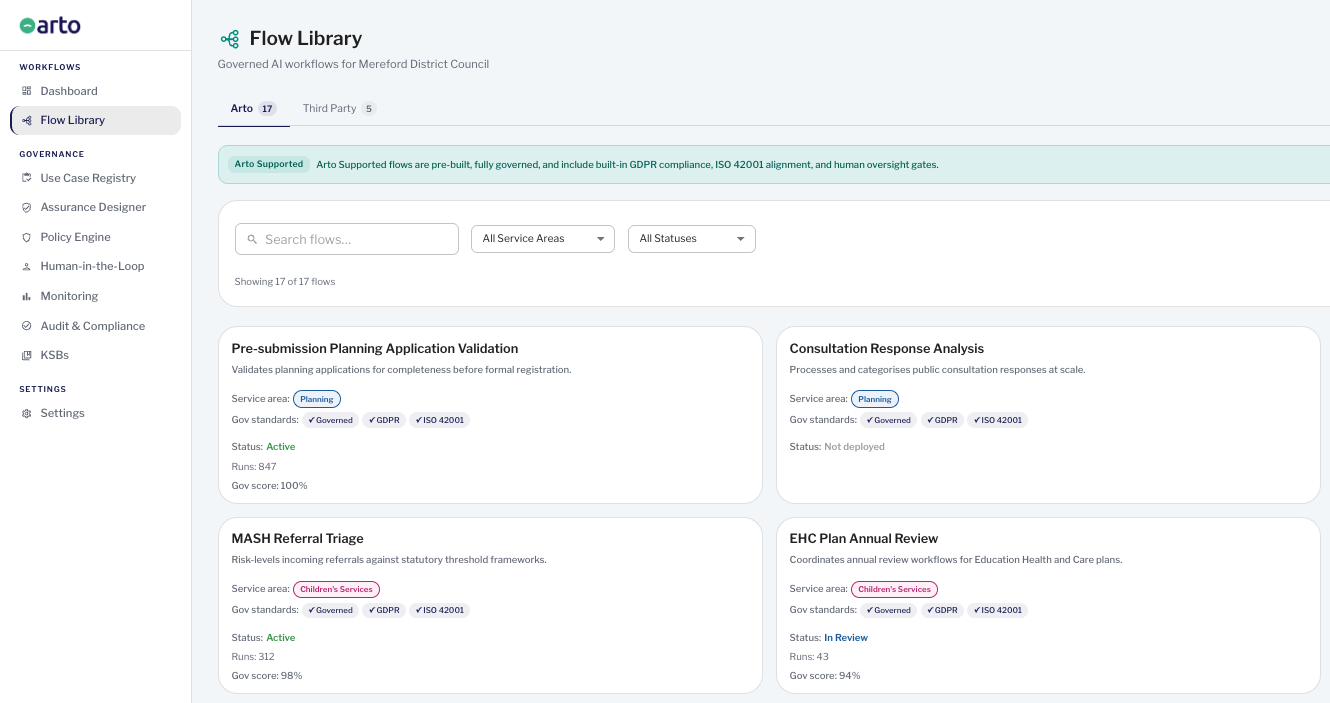
Pre-Submission Planning Application Validation
Arto intercepts planning applications from the Planning Portal before they enter the back-office system. It checks every submitted document, the planning fee, the description of development and the site location against the council's Local Validation Checklist, returning a structured validation report in seconds.
The problem this solves: Approximately 30% of planning applications are invalid on first submission: missing documents, incorrect fees, descriptions that do not match the drawings, or applications submitted to the wrong council. Each invalid application requires a planning officer to spend 30 to 45 minutes writing a formal validation letter. For a council receiving 1,500 applications per year, this can represent more than 200 officer days annually on administration alone.
Time saving: 30 to 45 minutes of officer time saved per invalid application. Approximately 30% of applications nationally are invalid on first submission.
For officers and the council
- Elimination of manual validation letter drafting for standard invalid applications
- Officers focus on planning judgement, not form-checking
- Consistent decisions, same Local Validation Checklist applied to every application, every time
- Automated audit trail of every validation decision for appeal purposes
- Reduced resubmission cycles, cleaner applications arrive from day one
For residents and service users
- Instant AI validation feedback before formal submission
- Dramatically reduced delay, the 8-week statutory clock starts immediately on a valid application
- Clear plain-English feedback on what is required and why
- Faster overall planning decisions
Consultation Response Analysis and Committee Report Drafting
Arto reads every public consultation response on a planning application, categorises each point by material planning consideration, detects and groups duplicate and templated responses, and drafts the consultation section of the committee report for officer review and approval.
The problem this solves:
For a contested planning application, reading and categorising consultation responses typically takes 3 to 5 hours. A case officer must read every submission, including hundreds of templated objections, categorise each point as material or non-material, and ensure every material consideration is addressed in the committee report. Planning inspectors have criticised officer reports for inadequate consultation analysis in significant numbers of appeal decisions.
Time saving: 3 to 5 officer hours per contested application.
For officers and the council
- 3 to 5 hours of manual consultation reading and categorisation eliminated per contested application
- Structured first draft of the consultation section, officer edits rather than writes from scratch
- Automated identification of material versus non-material planning considerations for officer confirmation
- Duplicate and templated response detection and grouping
- Automated statutory consultee chase emails for missing responses before committee deadline
For residents and service users
- Confidence that every representation submitted has been read and considered
- Transparent committee report showing how each concern was categorised and addressed
- Faster committee decisions
- Better quality decisions, all material considerations properly addressed reduces appeal risk
Children's Services workflows
EHC Plan Annual Review Orchestration
Arto monitors the EHC plan register, identifies every plan due for its statutory 12-month review within the next eight weeks, sends structured advice requests to schools, health and social care, chases missing advice automatically, assembles a draft amended plan from the incoming advice and records the outcome in the back-office system.
The problem this solves
Every child with an Education, Health and Care plan has a legal right to a 12-month review. Only 36% of councils complete all reviews on time. SEND coordinators manage between 150 and 300 plans each and cannot manually track due dates, chase four to six professionals per review and process outcomes within the statutory deadline. With 638,745 EHC plans in England growing at 10.8% per year, and the statutory accounting override that allowed SEND deficits off council balance sheets ending in March 2026, late reviews carry direct financial and legal risk.
Time saving: Statutory compliance from approximately 36% to near 100% on-time reviews. 4 to 6 hours per week per SEND coordinator saved in chasing and scheduling.
For officers and the council
- Automated review scheduling, no manual caseload scanning required
- Automated advice requests to schools, health and social care
- Automated escalation reminders, system chases missing advice without coordinator involvement
- 4 to 6 hours per week per SEND coordinator saved in chasing and scheduling
- Structured draft amended plan assembled from incoming advice, coordinator reviews and approves
- Real-time compliance dashboard: on track, at risk and overdue plans in a single view
- Audit trail for Ofsted inspections and Local Government Ombudsman investigations
For residents and service users
- Statutory 12-month review completed on time
- Advance notice of upcoming review with proper preparation time for families
- Consistent experience regardless of which coordinator manages the case
- Faster plan amendments issued within the 4-week statutory post-review deadline
- Reduced tribunal applications, timely reviews are the single biggest driver of reduction
MASH Referral Triage and Allocation
Arto reads incoming safeguarding referrals from all intake channels, extracts key information, checks previous case history, applies the council's threshold framework systematically and produces a structured triage summary for the duty social worker, before they begin their professional assessment. Arto does not replace the social worker's decision. It provides structured AI-assisted analysis so that every decision starts from a complete picture.
The problem this solves
The Multi-Agency Safeguarding Hub receives all incoming safeguarding referrals from schools, police, health, other agencies and the public. A typical MASH team receives 50 to 150 referrals per week. Triage takes 20 to 40 minutes each. Ofsted has highlighted inconsistency in threshold decision-making as a quality concern across numerous inspections. Two social workers reading the same referral may reach different threshold decisions, with serious consequences for the children involved.
Time saving: 20 to 40 minutes of triage analysis time reduced per referral. Consistency of threshold decision-making addressing Ofsted quality concern.
For officers and the council
- Structured AI triage summary ready for the duty social worker, they review and decide rather than starting from scratch
- Automatic previous history check before the decision is made
- Threshold framework applied consistently to every referral, every time
- Audit trail demonstrating consistent decision-making, essential for Ofsted inspections and serious case reviews
- Reduced paperwork for standard referrals
For residents and service users
- Faster response to safeguarding concerns, initial triage analysis within minutes of referral receipt
- More consistent threshold decisions, every family receives the same rigorous analysis regardless of who is on duty
- Appropriate allocation to the right service first time
- Earlier identification of escalating risk patterns, previous involvement flagged automatically
Revenues and Benefits workflows
Change of Circumstances Automation
Arto receives change of circumstances notifications from any channel, validates the information, recalculates council tax or housing benefit entitlement, generates the decision letter and updates the account — without officer intervention for standard cases.
The problem this solves
Change of circumstances is the highest-volume transaction in revenues and benefits. A typical billing authority processes 400 to 600 changes per week. Each requires 45 to 90 minutes of officer time to verify the notification, look up the account, recalculate entitlement, check for anomalies, generate a new bill or letter and update the account. Backlogs cause incorrect bills, failed direct debits, resident complaints and arrears accumulation.
Time saving: 45 to 90 minutes per standard change reduced to under 5 minutes. 70 to 80% reduction in manual processing volume for standard cases.
For officers and the council
- Standard changes processed end-to-end without officer intervention - 45 to 90 minutes eliminated per case
- 70 to 80% reduction in manual processing volume
- Officers focus on complex, exception and fraud cases
- Same-day processing eliminates backlogs
- Automated plausibility checks and anomaly detection
- Full audit trail for every automated decision, tribunal and appeal evidence generated automatically
For residents and service users
- Instant acknowledgement of change notification within seconds of submission
- Same-day account update
- Accurate bill or decision letter issued promptly
- Reduced risk of debt accumulating due to billing delays
- Consistent treatment, same rules applied to every change, every time
Enforcement Vulnerability Screening
Before referring council tax debts to enforcement agents, Arto screens every account in the enforcement queue against vulnerability indicators across housing benefit, council tax reduction, social care, Disabled Facilities Grant and housing register data. Every account is RAG-rated. Welfare referrals are generated automatically for high-risk households. Enforcement referrals are paused for the highest-risk cases pending welfare contact.
The problem this solves
Councils have a legal and ethical duty to identify vulnerable debtors before enforcement referral. In practice this duty is almost universally carried out inadequately. The Local Government Ombudsman upholds thousands of complaints about inappropriate enforcement against vulnerable households annually. Compensation awards of GBP 500 to GBP 2,000 per upheld case are common. Enforcement agent fees add a minimum of GBP 310 per case to already unmanageable debts. A brief manual check, rarely going beyond housing benefit, is the typical response to a legal obligation that requires systematic screening across all vulnerability indicators.
Time savings: Reduction in Ombudsman complaints and compensation payments (GBP 500 to GBP 2,000 per upheld case). Enforcement agent fees avoided for highest-risk cases (minimum £310 per case).
For officers and the council
- Automated screening of the entire enforcement queue before each referral batch
- Structured vulnerability report for each flagged case with specific indicators
- Significant reduction in Ombudsman complaints and compensation payments
- Demonstrates due diligence to auditors, courts and the Ombudsman
- Automatic warm referral to welfare team for RED-rated cases
- Audit trail showing every case was screened, essential for Ombudsman defence
For residents and service users
- Vulnerable households identified before enforcement agent contact, not after the visit
- Appropriate offer of payment arrangement or welfare referral before any enforcement action
- Reduced likelihood of enforcement fees being added to an already unmanageable debt
- Consistent treatment, every household screened against the same vulnerability indicators
Additional service areas covered by the Arto workflow library
Housing
Case management, homelessness assessment, allocations processing and repairs triage.
Adult Social Care
Care needs assessment support, continuing healthcare screening and safeguarding referral processing.
Contact Centre
Demand management, deflection, triage and channel shift automation.
Environmental Health
Licensing, complaint triage and inspection scheduling workflows.
HR and Workforce
Policy enquiry handling and onboarding process automation.
Your service area
If your service area is not listed, Arto builds the workflow with you. Every custom workflow inherits the same governance foundation as the pre-built flows.
If you already have AI workflows or want to build your own
Arto is not a closed workflow system. Organisations can register and govern AI workflows built in third-party tools alongside their Arto Supported Flows.
Third-Party Flows, workflows built in tools such as Flowise, N8N or Copilot Studio, are registered in the Arto workflow library and surfaced in the Use Case Registry alongside Arto Supported Flows. The HITL Control Centre's third-party register gives governance leads visibility of which third-party tools have human-in-the-loop steps configured across the organisation. Governance for third-party flows is configured manually within Arto rather than inherited automatically.
For organisations that want to build entirely new workflows within Arto, the workflow builder provides a visual interface for creating governed AI processes without technical expertise. Every workflow built in the builder inherits the full governance framework from the moment the first element is placed on the canvas.
See a workflow running in your service area
Speak with the Arto team to see the relevant workflow running against real-world scenarios from your service area. We will show you the governance certificate, the audit trail and what the officer experience looks like from the first run.
-
Book a workflow demonstration
-
Understand how the governance works first