
What Redcar and Cleveland Council achieved
Redcar and Cleveland Council deployed Arto's contact centre workflow and reduced inbound demand by 28% within the first three months of going live. Officers who had previously handled enquiries that could be resolved through automated deflection were freed to focus on complex, high-value calls that required human judgement and local knowledge.
This is not a projected outcome or a modelled estimate. It is what happened at a named council within a defined timeframe from a governed AI deployment.

Contact centres in UK councils handle a disproportionate share of demand that other channels have failed to resolve. Residents call because the council website did not answer their question clearly, because their online form submission has gone unanswered, because they were transferred from another team and have to start again, or because they simply prefer to speak to someone.
The volume of inbound contacts is not falling as digital channels improve. In many councils it is rising, because each improvement in online services creates new complexity and new questions. At the same time, the types of calls reaching advisors are becoming more complex: residents managing benefit changes, housing issues, social care referrals and complaints that require multi-team resolution rather than a single answer.
The result is a contact centre under permanent pressure: advisors handling complex calls with insufficient time between them, managers unable to release staff for training or improvement work, and service leads trying to justify a staffing model that cannot scale to meet demand without significant additional cost.
In short: Contact centre demand rises not because residents need more help, but because other channels are not resolving their needs. AI that addresses the root cause, resolving low-complexity, high-volume enquiries that should never reach an advisor, reduces pressure at source rather than adding capacity at the end.
What the Arto contact centre workflow does
AI reduces contact centre demand by intercepting, triaging and resolving enquiries before they reach an advisor, or by providing advisors with structured information that significantly reduces handling time when they do speak to a resident. The Arto contact centre workflow does this across the full contact journey.
Step 1 Triage and intent identification
When a resident contacts the council through any channel (telephone, web chat, online form, or digital self-service) the AI reads the contact intent and classifies the enquiry type. Is this a council tax query? A housing repair report? A benefits question? A complaint? The classification happens before the contact reaches a queue.
Arto: Identifies the contact type from the incoming text, voice transcript or form submission. Routes to the appropriate resolution path automatically.
Step 2 Automated deflection for resolvable enquiries
For enquiry types where the answer is known, consistent and does not require officer judgement, the AI provides a direct resolution without requiring advisor involvement. Account balance queries, opening hours, how to submit a form, status of a submitted application: these can be resolved immediately, at any time of day, without consuming advisor time.
Arto: Resolves low-complexity, high-volume enquiries through automated response. For each resolved contact, a full record is generated: what was asked, what was provided, and when.
Step 3 Structured triage for complex contacts
For contacts that do require advisor involvement, the AI assembles a structured triage summary before the advisor picks up the call or opens the chat. The advisor sees: what the resident's enquiry is, what information the resident has already provided, what their account history shows, and what the likely resolution path is. The advisor starts the interaction informed, not starting from scratch.
Arto: Generates a structured pre-contact brief for the advisor. Reduces the information-gathering phase of the call. The advisor focuses on resolution rather than diagnosis.
Step 4 Human sign-off on any action that affects the resident
Any action that directly affects a resident's account, entitlement or service (a change of address, a payment arrangement, a service referral) requires a named officer to review and approve before it proceeds. The advisor reviews the AI's proposed action, confirms it, and the decision is recorded permanently against both the case and the officer who approved it.
Arto: Human oversight is enforced at every action point. No consequential change proceeds without officer review and recorded sign-off. Both the AI recommendation and the officer decision are preserved in the audit trail.
Step 5 Outcome tracking and demand measurement
After each contact is resolved, the outcome is recorded and categorised: deflected without advisor involvement, resolved with advisor support, escalated to another team. These records are aggregated in real time, giving the contact centre manager a live view of deflection rates, resolution rates and demand trends. The Redcar 28% figure came from this measurement.
Arto: Tracks deflection and resolution automatically from the first run. Organisations input their own baseline contact volume and see the demand reduction figure against it.
How governance works in the contact centre workflow
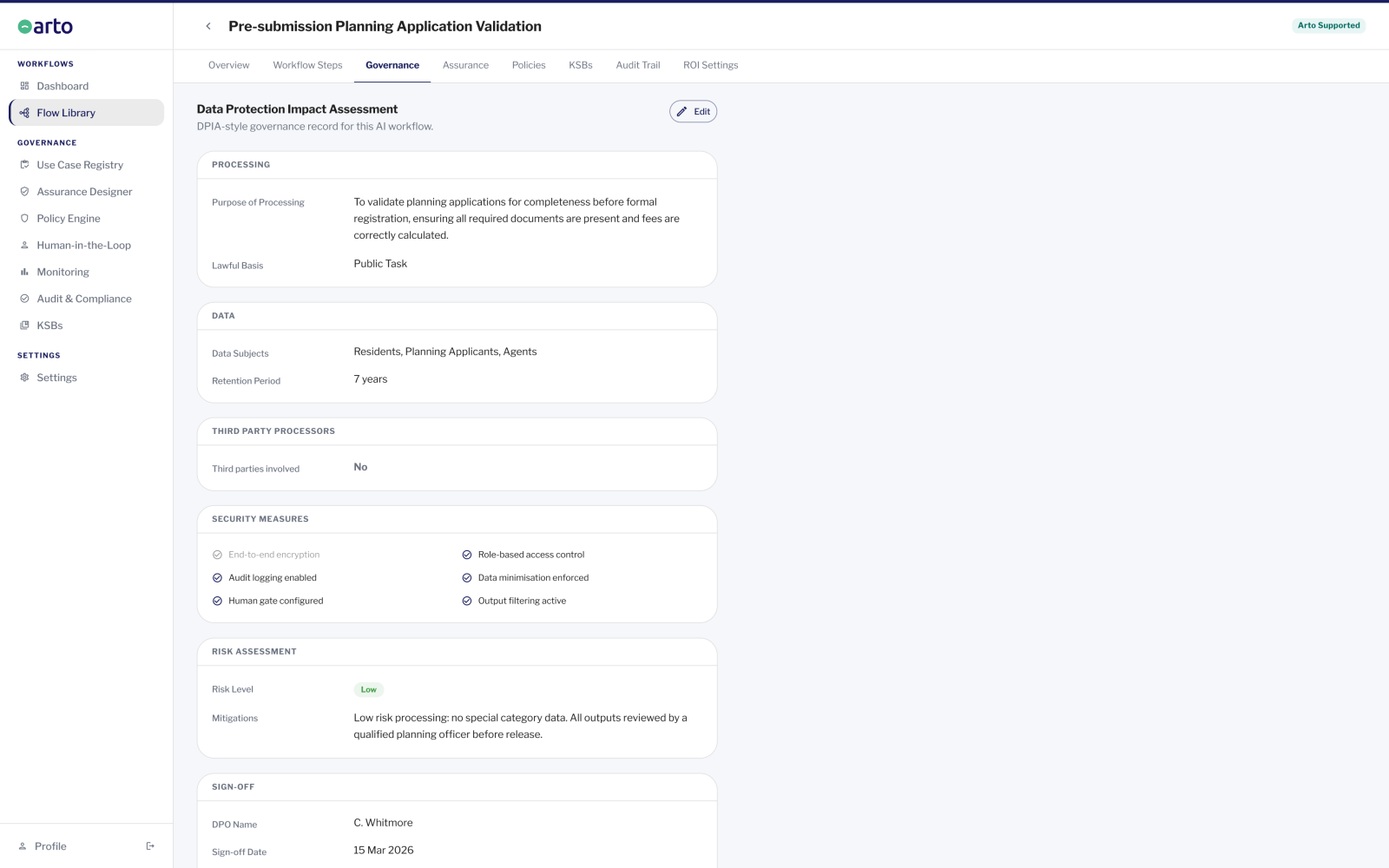
The Arto contact centre workflow operates within the same governance infrastructure as every other Arto Supported Flow. Governance is not an add-on configured after the workflow is live, it is embedded in how the workflow operates from the first contact.
Full audit trail
Every contact is recorded: what was asked, what the AI did, whether an advisor was involved, what the outcome was. The record is immutable, timestamped and available for ICO review or legal challenge.
Human oversight enforced
No action that affects a resident's account or entitlement proceeds without officer review and sign-off. The officer's decision is attributed, recorded and permanent.
UK data stays in the UK
Resident data processed through the contact centre workflow is hosted on AWS London. It never leaves the UK and is never used to train AI models.
What reducing demand means for contact centre staff
Reducing contact centre demand with AI does not mean reducing contact centre staff. It means changing the nature of what those staff are asked to do.
Advisors in councils that have deployed contact centre AI consistently report the same change: fewer calls that should have been resolved online and are not, more calls that require genuine human engagement, and more time to handle each call properly. The proportion of contacts that require advisor expertise increases as a share of total contacts. The volume of contacts that consume advisor capacity without requiring advisor skill decreases.
For contact centre managers, this creates the conditions for staff development and quality improvement that are impossible when every advisor is handling back-to-back low-complexity contacts. Training time, supervision time and the ability to handle surge demand without crisis become realistic for the first time.
Where to go from here
Read the Redcar and Cleveland case study
The full account of how the deployment worked, what the council did, and what changed.
Case studiesExplore all available workflows
Contact centre is one of six service areas with Arto Supported Flows. See what is available across planning, children's services, revenues and benefits, and more.
Workflow libraryUnderstand the governance
If you are a governance or IT lead who needs to understand what approval requires, the governance section has the full picture.
Governance