
Not all AI involvement in casework is the same
Casework in local government ranges from highly sensitive professional decisions (safeguarding threshold assessments, care plans, complex tribunal cases) to high-volume routine transactions that follow defined rules. AI involvement looks fundamentally different across this spectrum. Understanding which mode applies to a given service area is the starting point for any casework AI deployment.
Triage support
AI produces a structured analytical summary to inform a professional decision. The professional makes the decision. AI involvement is explicit, documented, and does not substitute for human judgement.
AI does: Reads all incoming information. Extracts key facts and risk indicators. Checks previous case history. Applies the relevant framework (threshold criteria, risk matrix, eligibility criteria). Produces a structured summary and flags gaps or uncertainties.
Officer does: Reviews the AI-produced summary. Applies professional knowledge and contextual judgement. Makes the decision. Records their decision alongside the AI summary. Can override, qualify, or reject the AI analysis at any point.
In Arto: MASH safeguarding triage: Arto produces a structured triage summary for the duty social worker. Arto does not replace the social worker's decision. It provides a structured AI-assisted analysis before the decision is made, every time.
Casework orchestration
AI manages the administrative and coordination workflow around complex casework. Scheduling, chasing, drafting, tracking deadlines, assembling documents. The professional focuses on the casework itself, not the administration that surrounds it.
AI does: Monitors caseload for trigger events. Sends scheduled communications to professionals, families and organisations. Chases outstanding actions. Assembles incoming information. Drafts documents from assembled information for officer review. Tracks statutory deadlines and alerts when cases are at risk.
Officer does: Reviews AI-assembled information and drafts. Applies professional judgement to identify gaps, errors and contextual nuances the AI cannot assess. Approves, amends or rejects each AI-produced output. Makes all decisions about how the case proceeds.
In Arto: SEND EHC plan annual review: Arto monitors the review schedule, sends advice requests, chases outstanding contributions, and assembles a draft amended plan. The SEND coordinator reviews everything and makes all decisions about what changes to the plan.
Transaction automation
AI processes standard, rule-defined transactions end-to-end without officer intervention for routine cases. Exceptions, anomalies, and complex cases are routed to officer review. The officer reviews outputs, not inputs.
AI does: Receives the transaction from any channel. Validates it against defined rules. Calculates the output (liability, entitlement, decision letter). Checks for anomalies and plausibility. Generates all required outputs (letters, account updates, notifications). Routes exceptions to the officer review queue.
Officer does: Reviews the officer queue: exceptions, anomalies, cases that failed plausibility checks, and cases that require a discretionary decision. For automated cases, the officer reviews the output record rather than processing the transaction. Approves before any consequential action.
In Arto: Revenues and benefits change of circumstances: 70–80% of standard changes processed end-to-end automatically. Complex cases, anomalies and discretionary decisions routed to officer review. No automated case proceeds without officer approval.
In short: Triage support is about decision quality: better information for the professional making a high-stakes decision. Casework orchestration is about capacity: freeing caseworkers from administration so they can do the case work. Transaction automation is about throughput: processing high volumes of routine transactions that follow defined rules, with exceptions handled by officers.
Casework and triage capabilities by service area
Arto has pre-built workflows for casework and triage across four service areas with active POC specifications. The capabilities differ significantly by service area. The mode of AI involvement and the type of casework it supports vary depending on the nature of the work.
Children's Services: MASH Triage support Structured AI triage summary for every incoming safeguarding referral, before the duty social worker makes their threshold decision. Previous case history checked. Threshold framework applied consistently. Arto does not replace the social worker's decision. Key figure: 20–40 minutes per referral for structured triage analysis | Children's Services: SEND Casework orchestration Automated monitoring of EHC plan review schedule. Advice requests to schools, health and social care. Chasing of outstanding contributions. Assembly of draft amended plan from incoming advice. Statutory compliance from ~36% to near-100% on-time reviews. Key figure: 4–6 hours per week per SEND coordinator in chasing and scheduling | Planning Casework orchestration Validation of planning applications against the Local Validation Checklist before officer involvement. Analysis of consultation responses for contested applications: material vs non-material considerations categorised, draft consultation section produced. Key figure: 30–45 min per invalid application; 3–5 hours per contested application consultation analysis | Revenues and Benefits Transaction automation Standard change of circumstances processed end-to-end: account lookup, entitlement calculation, plausibility checking, decision letter generation, account update. 70–80% of standard changes automated. Complex and exceptional cases routed to officer. Key figure: 45–90 minutes per change reduced to under 5 minutes for automated cases. 70–80% automation rate |
The safeguarding position: what AI does and does not do in MASH triage
Safeguarding triage in a Multi-Agency Safeguarding Hub requires a duty social worker to make a threshold decision on every incoming referral: is this a Section 47 child protection enquiry, a Child in Need assessment, Early Help, or No Further Action? That decision carries legal weight. It must be made by a qualified professional who applies both the council's threshold framework and their own professional knowledge of the child's and family's circumstances.
Arto does not replace the social worker's decision.
It provides a structured AI-assisted analysis before the decision is made, every time.
What Arto produces for MASH triage is a structured pre-decision analysis: a summary of the referral information, an automatic check of previous case history in the back-office system, an application of the council's threshold framework to the referral criteria, and a flag of any information gaps that would affect the quality of the decision. This analysis is ready before the duty social worker opens the referral.
The duty social worker reads the Arto summary, applies their professional knowledge and contextual judgement, and makes the threshold decision. Both the Arto analysis and the social worker's decision are recorded in the audit trail, with the social worker's decision attributed to them by name. Where the social worker's decision differs from the Arto suggestion, the reason can be noted.
What this means for Ofsted inspections
Ofsted has highlighted inconsistency in MASH threshold decisions as a quality concern across multiple inspections. Two different duty workers reading the same referral can reach different threshold decisions, a problem that stems from the manual, unstructured nature of the current triage process. Arto addresses this by applying the council's threshold framework consistently to every referral, every time — not instead of the social worker's judgement, but before it.
The audit trail for every triage decision (the AI analysis, the social worker's decision, and the attributed record) provides the documentary evidence that Ofsted expects to see: consistent process, professional accountability, and a complete record of how every referral was handled.
What this means for the social worker
The most common concern among social workers when AI is introduced to triage is that it will reduce the professional judgement element of the role or be used to justify cutting headcount. In the MASH triage context, AI does the opposite: it takes the administrative and information-gathering burden off the duty worker and gives them a structured brief before they review the case. The social worker spends more time on professional analysis and less time on information retrieval. The decision remains entirely theirs.
What KSB-mapped AI means for casework
KSB stands for Knowledge, Skills and Behaviour: the professional frameworks that define the scope of a public sector role. Every professional qualification and role profile in local government is built around KSBs: what you need to know, what you are trained to do, and what decisions you are accountable for making.
Arto's AI agents in casework workflows are mapped to the KSB profile of the specific role they support. This means the AI agent's scope (what it analyses, what it recommends, what information it accesses) is defined by the professional framework of the human role it is assisting, not by what the AI is technically capable of doing. A MASH triage AI agent operates within the KSB boundary of a duty social worker role. A SEND EHC review agent operates within the boundary of a SEND coordinator. A planning validation agent operates within the boundary of a planning officer.
In practice, KSB mapping means the AI agent applies the same framework criteria, the same professional knowledge, and the same scope boundaries that the officer themselves would apply, but it applies them automatically, consistently, and for every case without fatigue or distraction. The officer's role is to review, contextualise, and decide. The AI's role is to prepare, analyse, and present.
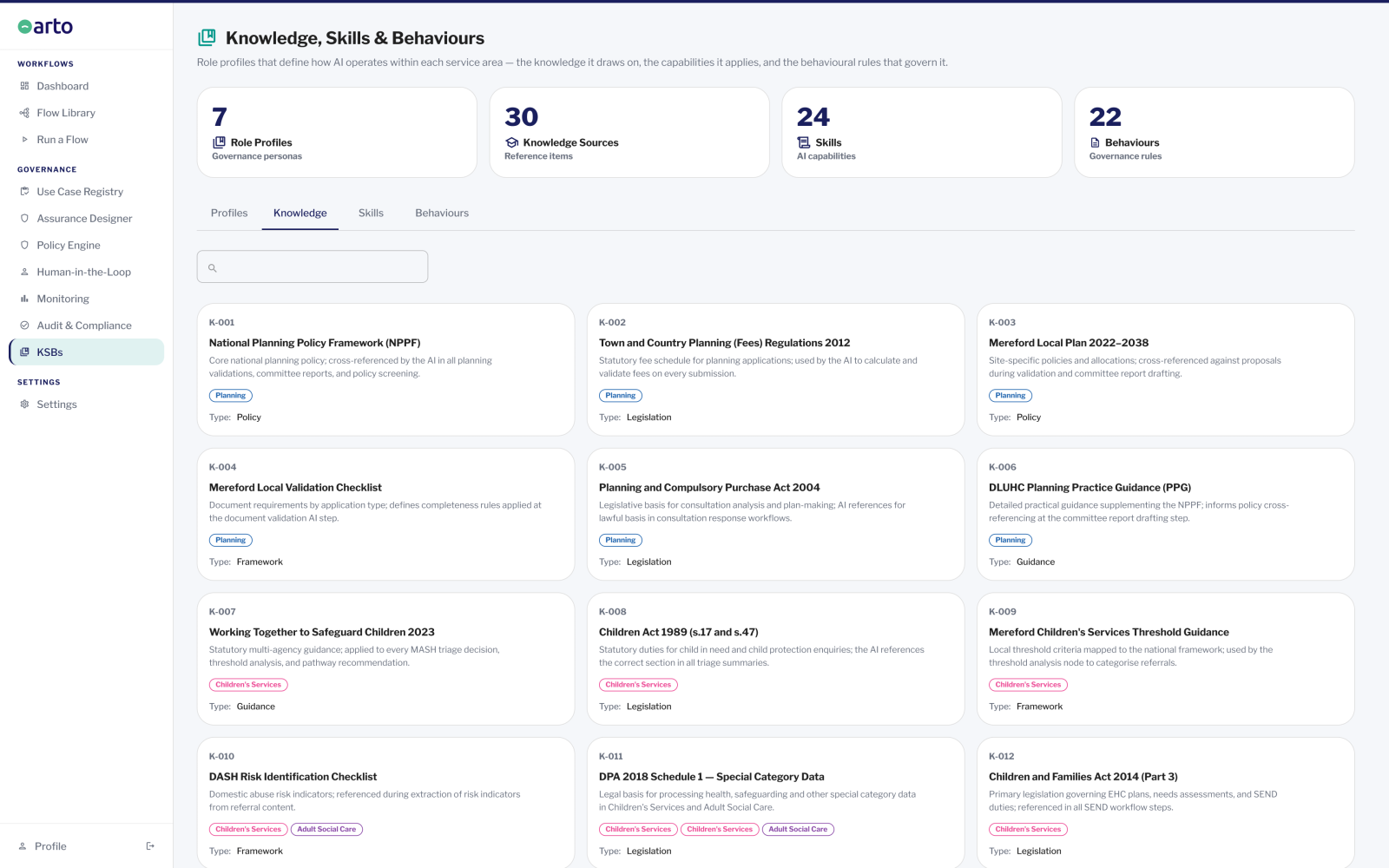
KSB mapping in the three triage and casework contexts
- MASH triage: the AI agent applies the council's threshold framework, the criteria that define what level of concern meets each response pathway. These criteria are the professional knowledge that a trained social worker uses. KSB mapping ensures the AI applies them as a trained social worker would, not as a general-purpose AI tool would.
- SEND EHC review: the AI agent understands the statutory deadlines, the required evidence contributors, and the sections of an EHC plan, which is the knowledge and skill framework of a SEND coordinator. It manages the review process within that framework, escalating to the coordinator when the situation falls outside defined parameters.
- Planning validation: the AI agent applies the council's Local Validation Checklist, the specific knowledge framework that defines what constitutes a valid application for each application type. It does not exercise planning judgement; it checks applications against the checklist as a validation officer would.
Governance in casework: every decision attributed, every case documented
In casework contexts, governance means one thing above all others: every decision that affects a resident, a family, or an individual must be attributable to a named professional who is accountable for it. AI-assisted casework that produces undocumented decisions, or decisions where the professional's involvement cannot be demonstrated, is not legally defensible.
Arto's casework workflows enforce human oversight at every decision point. The HITL Control Centre presents the AI analysis and the officer makes their decision, which is recorded against their name, with a timestamp, and with the full context of the AI's analysis. For a triage decision in MASH, the record shows what the AI summary said and what the social worker decided. For an EHC plan amendment, the record shows each AI-drafted change and what the SEND coordinator approved. For a revenues case, the record shows what the automated process calculated and what the officer confirmed. The audit trail is complete, immutable and searchable.